Monday, July 22, 2013

Boom Boom Feliz Ramadan


These are the theme songs for my weekend: http://www.youtube.com/watch?v=JNfwInxcqoo
http://www.youtube.com/watch?v=qGJ9S3Is6lY

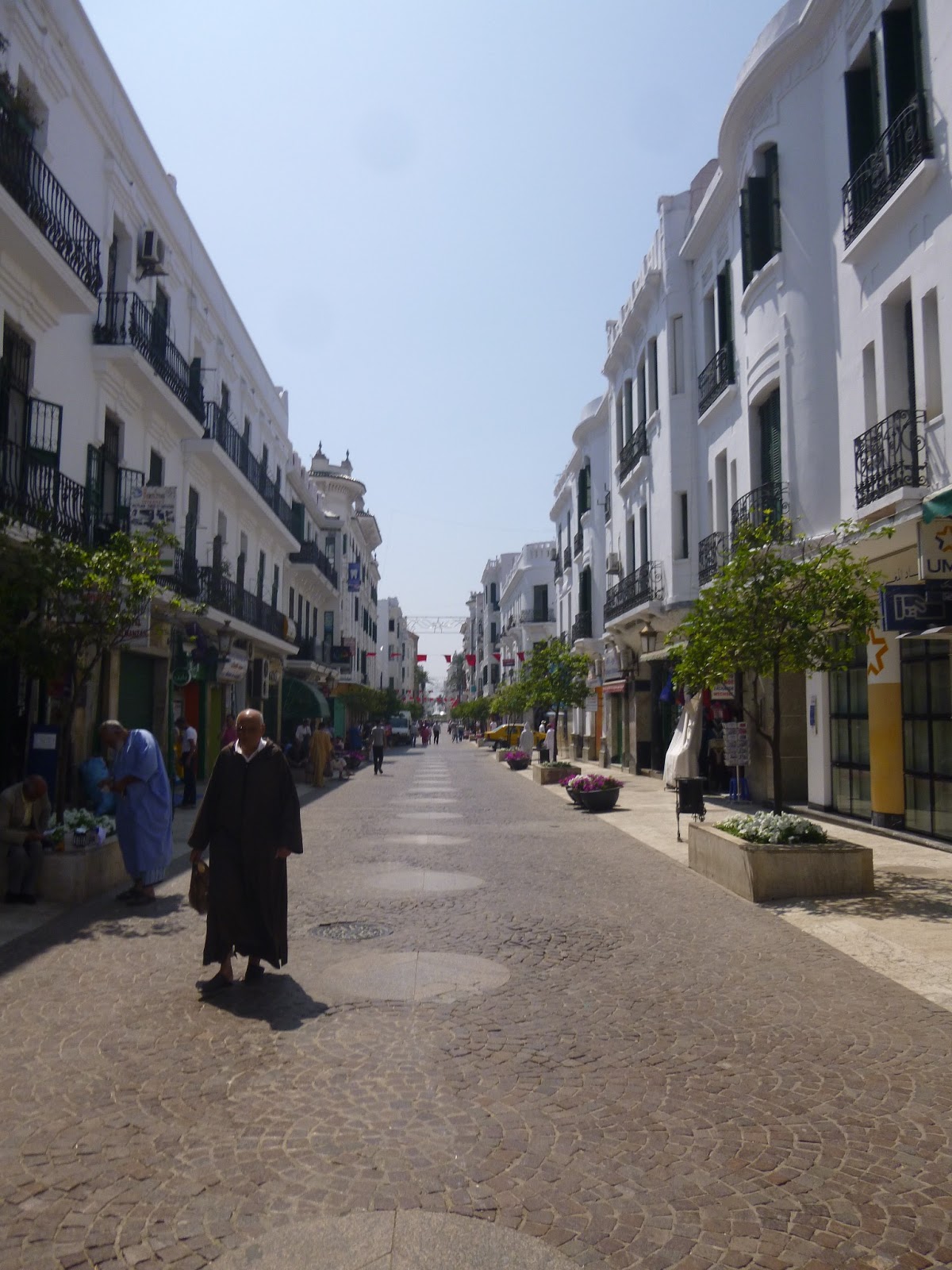
I just returned by train from Tangiers to Meknes. Three friends and I spent an incredible and exhausting weekend in Tetouan exploring northern Morocco and swimming in the Mediterranean. The region of Tetouan and Tangiers is remarkably different in some ways. Mainly, the Spanish influence is much more pronounced. Here in Meknes, everyone tries to speak to me in French. In Tetouan, there were more attempts at Spanish. Even when speaking to people in Arabic, they would respond with "Si, si." The architecture looks very Spanish, but I was reminded a number of times that what we consider to be Spanish design is in fact Islamic and Arab in origin.

We arrived in Tangiers around 10pm on Friday and took an hour long cab ride to Tetouan. The cabbie was young and reckless and sped through the mountain roads at an unnerving speed. When we finally found our hotel on the third floor of a bank it was close to midnight. Here are some of the views from our $10 hotel room:


The brownish building in the second picture is a nice church located right on the circle. It is the third or fourth church I have seen in Morocco. They are all well-maintained but I don't know how populated they are. 

Tetouan is easily my favorite Moroccan city so far. It is beautiful, has yet to be discovered by tourists, and it is surrounded by crooked mountains and farmland. It has wide streets and fountains every few blocks along with the narrow, white passageways typical of Arab old cities. It is set back from the sea by about thirty minutes, but it was easy to get a cab to take us there and we spent most of Saturday laying on the beach.


If you look closely as the second picture, you can see a man shooting up out of the water on a type of jet ski that I've never seen before. He would get 20+ feet up in the air on a small, water-propelled platform before diving back into the sea. The water was the perfect temperature and when the sun started to set we had the beach to ourselves. Other than hearing the call to prayer off in the distance, everything was silent. 
The next day we walked around Tetouan and found one of the few restaurants that stays open during Ramadan, El Reducto. It is an old riad repurposed as a hotel by a Spanish family. 


After enjoying fried eggplant and potatoes, fresh-squeezed orange juice and some of the best mint tea I've had yet, we headed upstairs to explore and relax on the roof until we had to head back to Tangiers to catch our train. Here are some more pictures of the trip:


Sunday, July 14, 2013

عاصمة المغرب

My roommate and two other girls took a train from Meknes to Rabat yesterday morning. The ride was only two hours and it was a great opportunity to see the Moroccan countryside. There were shepherds, huts made out of bales of hay, and rolling hills with rocky creeks. The train ride was so enjoyable I almost did not want it to end and I am planning more of them (to Fes, Assilah, etc.).

When we arrived in Rabat we hailed a cab that took us to the beach town of Temara. We drove along the water's edge looking for a beach that wasn't too crowded or too rocky.


We finally settled on one situated next to a theme park complete with a merry-go-round and carnival rides next to a gaudy hotel. We went into the hotel looking for a place to change. It looked completely abandoned on the inside.

After changing we returned to the beach and I started to haggle with some guy over an umbrella that I wanted to rent. He was trying to charge me 50dh. After settling on 20, he sets it up for me. So far, during Ramadan, I've tried to be really discreet about any eating or drinking I do during the day, including in the classroom. But yesterday I felt that the beach would have to be an exception. I was starving and thirsty, and there was no way I was spending the day on the hot beach without drinking water in front of people. There were other foreigners there, so I figured it would not be a problem. How Moroccans get by laying on the beach all day and swimming without eating or drinking anything is beyond me. I am constantly shocked by the things they are able to do while fasting from 4am until 8pm. Anyways, I was holding a bottle of water and after the guy set up the umbrella the questioning began:

"Can I ask you something?"
"Sure."
"Why aren't you fasting?"
"Because I'm not a Muslim."
"You're not a Muslim?"
"No."
"What religion are you?"
"I'm a Christian."
"Oh..."

It's disappointing that even when I try to be blunt with people I still have to lie. My normal response to "What religion are you?" is "My family is Christian." At least that's not as much of a lie. But here is what they say when I mention that during Ramadan:

"You know, Christians fast, too. And for longer than Muslims." 
"Maybe Coptic Christians..." I say.
"No, real Christians fast."
"Then I'm not a real Christian."

I need to mention here that I think Ramadan is amazing and one of the more respectable religious traditions. It is meant to remind the wealthy, and everyone else, that there are people in the world that experience severe hunger and thirst and don't have the luxury of breaking fast when the sun goes down. It's a time of generosity and self-control. It teaches patience and compassion. Again, I am in awe of what most Muslims are capable of doing this time of year, especially in a place like central Morocco. That being said, I do not feel like abstaining from all food and drink for 16 hours a day in 105+ degree heat is something that one just jumps into as a non-Muslim American. In addition to that, I have been so irritated by the American students that have decided to "fast" that I do not want to be a part of it. By 10am they are complaining of hunger pains. If you eat anything in front of them, they see it as an opportunity to remind everyone of their suffering. You then see them drinking water and realize they are only abstaining from food. Upon further questioning they say they are only fasting half a day. Not eating anything until after noon sounds like a pretty normal day for me, but for them it is a life-changing cultural experience.

 It is hard to determine the boundaries on cultural respect and cultural immersion. I try to be aware of the fact that the Moroccans around me are facing a real challenge every day and it is rude to blatantly eat and drink in front of them but I also know that it can take a lifetime of observation, training, and faith that I do not have to be able to fast for a month every year. I do not want to pretend that I can do what they are doing, because I probably cannot. Because of my mixed feelings about what should be deemed respectful, I just do not know how to react when my professor walks into our classroom during our break, sees me eating a pretzel in the far corner of the room and says, "Look at Hannah, eating during Ramadan in broad daylight!"

Anyways, back to Rabat. We swam and laid on the beach for hours. The water was surprisingly chilly and the breeze was cool. It was the first time I have felt cold in weeks so it was nice.


We drove around Rabat for a while, looking for any restaurant that would be open before iftar. We finally found one and ate crepes and paninis while trying to decide what to do with the rest of the evening. I ended up taking the train back by myself around 9:30 while the others stayed to check out Rabat's nightlife. I shared a compartment with Abdou, a Moroccan-born French pianist who was returning to Fes to visit his mother after his father passed away. We talked about religion, marriage, and politics (a rare subject of conversation in Morocco, at least for me). 

When I arrived back in Meknes around midnight I did not have to look far for a cab since the drivers were standing in the station searching for customers. I went with one cabbie who told me the ride would be at least 25dh. I am used to just going by the meter and that seemed a little steep. I reluctantly agreed on 20 and got into the backseat of his cab after he tried to get me to sit up front. I am still trying to determine what precautions I need to take while riding in a cab. This is what I have come up with so far: Always sit in the back seat. Pay attention to where he is taking you and get out and find another cab if he is clearly taking the wrong route. Don't get into a cab with only male passengers in it. The last one I have not followed strictly but after three more men piled into this cab with me, I got out and walked down the street to find a different one. I am sure it would not have been a problem, but since the cabbie was bothering me to begin with, I decided to bail. I found an empty cab half a block away and got in. The driver seemed nice and as we started to drive off, someone was yelling into my back seat window and opened the door. Apparently it was the man in charge of the taxis around the train station. He was insisting I get out of the cab and go back to the one I was in before. I suppose they have a system there that he wanted to abide by, but I was sick of getting in and out of taxis and told him repeatedly that I did not want that other taxi. He started screaming at the driver and the driver was screaming back and was trying to drive off but the guy would not let him. At this point I really wasn't going to get out of the cab and explained that I did not want to be in a cab alone with four men (if there's one thing Moroccans will understand, it's a woman trying to be safe/virtuous). The guy kept screaming and I could not believe how insistent he was being. Finally we just started to drive off and the guy slammed the door in my face. My cabbie was obviously flustered and seemed just as confused as me. I was happy he stuck up for me, even if it was just for the cab fare. We had a good conversation about Amazighi culture and language before he dropped me off.


Wednesday, July 10, 2013

Ramadan Kareem

My first Moroccan iftar was delicious... harira, shbekia, bastila, dates, flower-scented milk, Moroccan pizza, eggs, and juice. Great company and a beautiful tradition.

Tuesday, July 9, 2013

Misc pics


The first picture is of my friend Rachel and our two language partners. We were getting gelato and crepes at a swanky cafe in the new city. There are also two pictures of the shbekia baking process. Shbekia is a crunchy, sticky pastry that tastes like solidified molasses with some spices and sesame seeds. It's delicious and is eaten along with harira, a savory meat and garbanzo bean stew. It's a weird combination, but it works. Supposedly it is eaten every night for Ramadan in Morocco so I probably won't think it's so delicious a month from now. The last three pictures are me experimenting with the miniature setting on my camera. The view is from the roof of my apartment building and the blurred edges of the photos are supposed to make everything look small...


Saturday, July 6, 2013

Moulay Idriss/Walili

It is so frustrating trying to type in Arabic on this blog. No matter how the text is oriented, the punctuation and the letters won't coincide. If anyone has any advice please let me know.

So, we set off for the Roman ruins of Volubilis (وليلي) today at 9am. It was a short 45min drive by bus to the ruins that are surrounded by olive trees and fields. The nearby town of Moulay Idriss was visible from the ruins. 

I've read that the site of Volubilis is the farthest site west of Rome. Our guide showed us the gorgeous tiles depicting Roman myths and described, in Arabic and in excruciating detail, the history of every stone that we saw while we huddled around him under the sweltering midday sun. The site was gorgeous and amazingly well-preserved. A splash of water on the dusty tiles revealed the brilliant colors of the mosaics. Unfortunately, I had left my SD card in my computer and only had the available memory on my camera (about 10 pictures). Fitting all of Volubilis and Moulay Idriss into 10 pictures is difficult, but I think I did a pretty good job.


After exploring the ruins and watching the storks fly to and from their nests on top of the ancient pillars, we relaxed on a shady patio and drank soda and photographed kittens until we were herded back into the vans. 

The town of Moulay Idriss is named after the man who brought Islam to Morocco. His mausoleum is in the center of the city, but only Muslims are permitted inside. The whole town actually used to be closed off to non-Muslims and it is still a devoutly religious place. All the houses hug a steep hill and we climbed a narrow maze of stairs (with the help of our guide) to the top of the city. It was a beautiful view and the kestrels, jackdaws, and swifts flying above us made it very picturesque.


We returned to the city center and drank fresh-squeezed peach juice while trying to cool off. I haggled with a vendor over a stone soap dish with a fossil embedded in it. Got it for 30dh! 

It was a great day trip, but the heat was overwhelming. I drank water non-stop and still felt dehydrated. In two days, practically every Moroccan will be abstaining from all food and drink from 4am until after 9pm. It's incomprehensible to me but everyone that I have talked to says you can simply trick your mind into not being thirsty and it's not a problem. I have no intention of fasting, but I'm still anticipating that Ramadan will be a very difficult time. 

Friday, July 5, 2013

delicious couscous followed by sketchy pedicures

After all my classes, which included my first test, I met my friends from the gallery (Mansour and Jamila) at Cinema Camera in the new city. My roommate and I walked with them to their beautiful apartment and they served us the traditional Friday couscous with leben (yogurt drink) followed by watermelon, tea, and cookies.


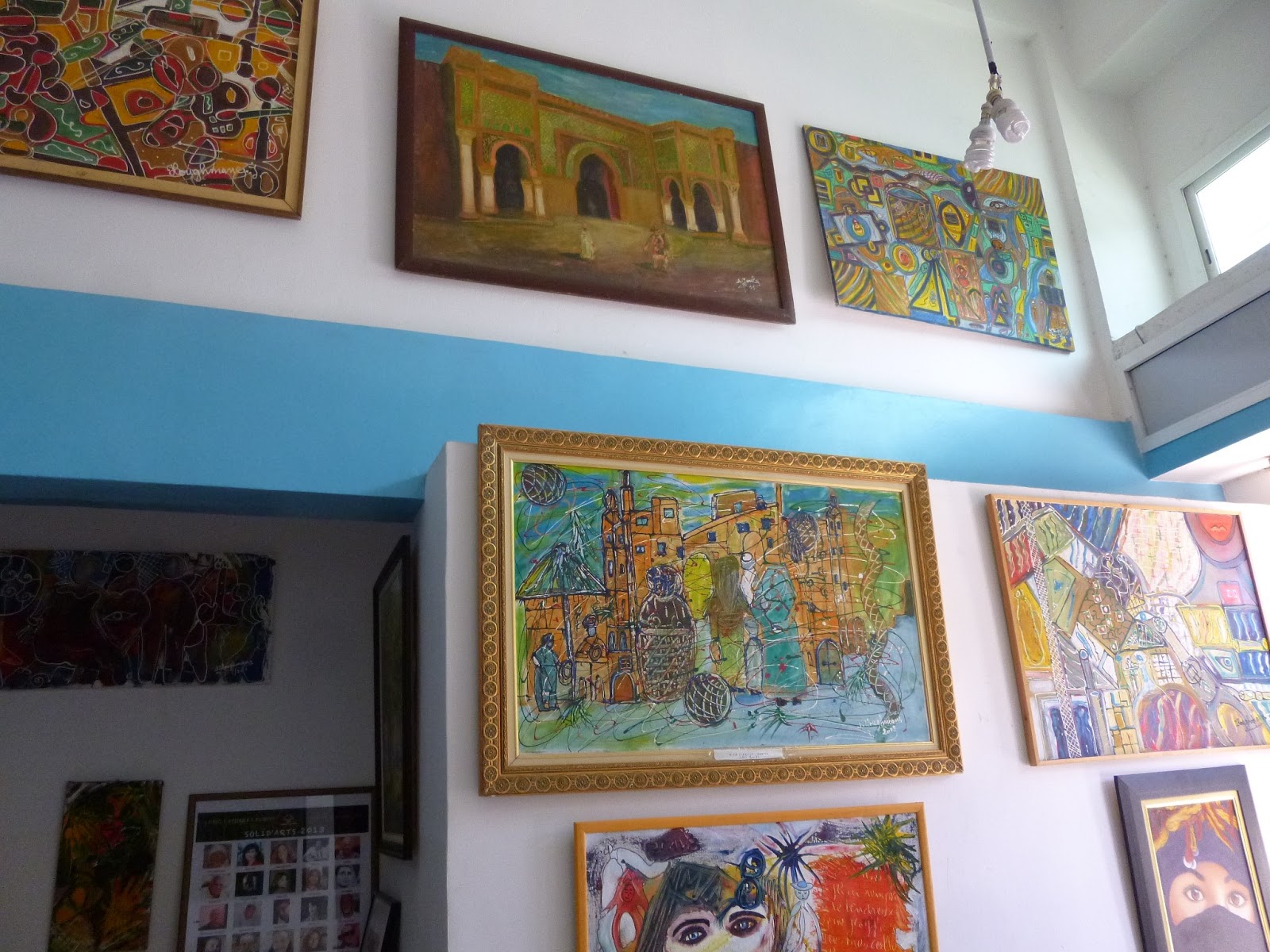
Afterwards, we went downstairs and right next door to their apartment complex is Jamila's art gallery, which consists mostly of her own work but also some other pieces by local artists. She gives drawing and painting lessons there as well.


When we left the gallery it was unbearably hot outside. There was a strong breeze that only blew hot air into our faces. All of the students are supposed to travel to Volubilis and Moulay Idriss tomorrow, but with this heat it seems unimaginable.

We headed home only to leave again a few minutes later back to the new city to look for a salon to get a cheap mani/pedi. Natalie and I went with our host sister and she took us to a very upscale, and somewhat expensive salon. It was all booked up so we went down the block to a cheaper one. The sanitary conditions were questionable but we went with it anyway and for 150 dirhams for everything, we weren't over paying. Halfway through my pedicure, a woman came in who said she had an appointment for a facial. Since all the employees were with a client, the woman doing my pedicure asked me if she could do both of us at the same time. ما كاينش مشكلة...

Since she really was alternating between a rubbing this woman's face and scraping dead skin off my feet, with no handwashing in between, I feel like I got the better end of the deal. This is the room I was in... it looks more like a run down hospital than a salon. I'll keep everyone updated if I end up with a rash worthy of a fear-inducing Cosmopolitan article.


Monday, July 1, 2013

Haggling in Morocco

Got my first Moroccan souq experience and made off with some nice jewelry for pretty cheap. I met this guy Abdullah in the old city who gives 66-75% off everything in his store to students studying at AALIM! My language partner and I drank mint tea with him as he explained the stories behind the different Moroccan rugs:

-The marriage rug: An old custom in this area of Morocco (again, all according to Abdullah) was that a young woman would weave elaborate rugs that told the story of her life. When a man was interested in marrying her he could examine the rug instead of her since seeing a girl before marriage was forbidden, except for by the groom's mother, who would then describe the girl to her son. Supposedly the men could tell a lot about the girls from their rug-weaving skills and their choice of colors and patterns.

-The Bedouin tent rug: The cheapest of the four types, but large and beautiful. They seem sturdy and are used by Bedouins to pad the ground of their tents. He was sure to mention that Bedouin tents are nothing like American tents-- they're more like large room with lots of rugs and cushions.

-The children's rug: These are rugs that are made/given as a gift when a child is born. They are probably my favorite because they have really bright colors and are lightweight. Very similar to a Western quilt but it looks like they're made with more silk and they're much more gaudy.

-The rheumatism-curing rug: This is the most expensive rug because it is made from camel hair. Supposedly if you wrap the blanket around you, you will be cured of rheumatism because of some special quality of camel fur.


And here are more pictures of the day: